What Is a Slab Leak and Why Is Long Beach So Vulnerable?
A slab leak is exactly what it sounds like — a leak in a water supply or drain line that runs beneath your home's concrete foundation slab. Because the pipe is buried inside or directly under concrete, the leak isn't visible until it has already caused significant water damage to the slab, surrounding soil, or flooring above.
Long Beach is one of the highest-risk cities in Southern California for slab leaks, and the reason comes down to history. The vast majority of the city's single-family housing was constructed between 1945 and 1975. Builders of that era commonly ran copper supply lines directly through and beneath the concrete slab — a technique that was standard practice at the time but has created widespread problems now that those pipes are 50 to 75 years old.
If you own a mid-century home in Long Beach, Signal Hill, East Long Beach, or Wilmington, understanding slab leaks isn't optional — it's essential homeownership knowledge.
Why Do Slab Leaks Happen?
Copper pipe embedded in concrete doesn't fail randomly. There are specific mechanisms at work in most slab leak cases:
- Electrolytic corrosion — When copper pipe sits in direct contact with concrete, a mild electrochemical reaction occurs over decades that slowly corrodes the outer pipe wall, eventually creating pinhole leaks
- Abrasion from soil movement — Southern California soil expands and contracts seasonally, and during seismic events the ground shifts. Pipes that pass through concrete experience repetitive micro-movements that gradually wear through the pipe wall at contact points
- Water chemistry — Long Beach's municipal water supply, while safe to drink, has mineral content and chloramine levels that can accelerate the pitting corrosion process on older copper pipe interiors
- High water pressure — Homes with chronically high water pressure (above 80 PSI) put continuous stress on all plumbing, accelerating corrosion and wear at every pipe section — including those buried in the slab
The Warning Signs You Should Never Ignore
Because the leak is hidden under concrete, homeowners often dismiss the early signs as minor annoyances. By the time they call a plumber, the leak has sometimes been running for weeks or months. Watch for:
- A sudden unexplained jump in your water bill — Even a small pinhole leak running continuously can add thousands of gallons to your monthly usage. If your bill spikes with no change in your habits, a slab leak is near the top of the differential diagnosis
- Warm or damp spots on the floor — Hot water line slab leaks transfer heat up through the slab, creating warm patches on tile, hardwood, or carpet that feel noticeably different when you walk barefoot
- The sound of running water when everything is off — Turn off every fixture and appliance in your home. If you can hear water movement in the walls or floor, or if your water meter is still spinning, water is going somewhere it shouldn't
- Low water pressure throughout the home — A leak large enough to affect supply pressure will manifest as weak flow at multiple fixtures simultaneously, not just one
- Cracks in flooring, tile grout, or baseboards — Water saturating the soil beneath the slab causes uneven settling that shows up as cracks in finish surfaces, particularly along the perimeter walls
- Mold or mildew odor — Persistent water under or within the slab creates ideal conditions for mold growth in the concrete and adjacent framing materials
How Long Beach Plumbers Detects Slab Leaks Without Tearing Up Your Floor
The days of jackhammering random sections of concrete hoping to find a leak are long behind us. Modern leak detection technology lets our technicians pinpoint a slab leak to within inches before any concrete is touched.
We use two primary detection methods:
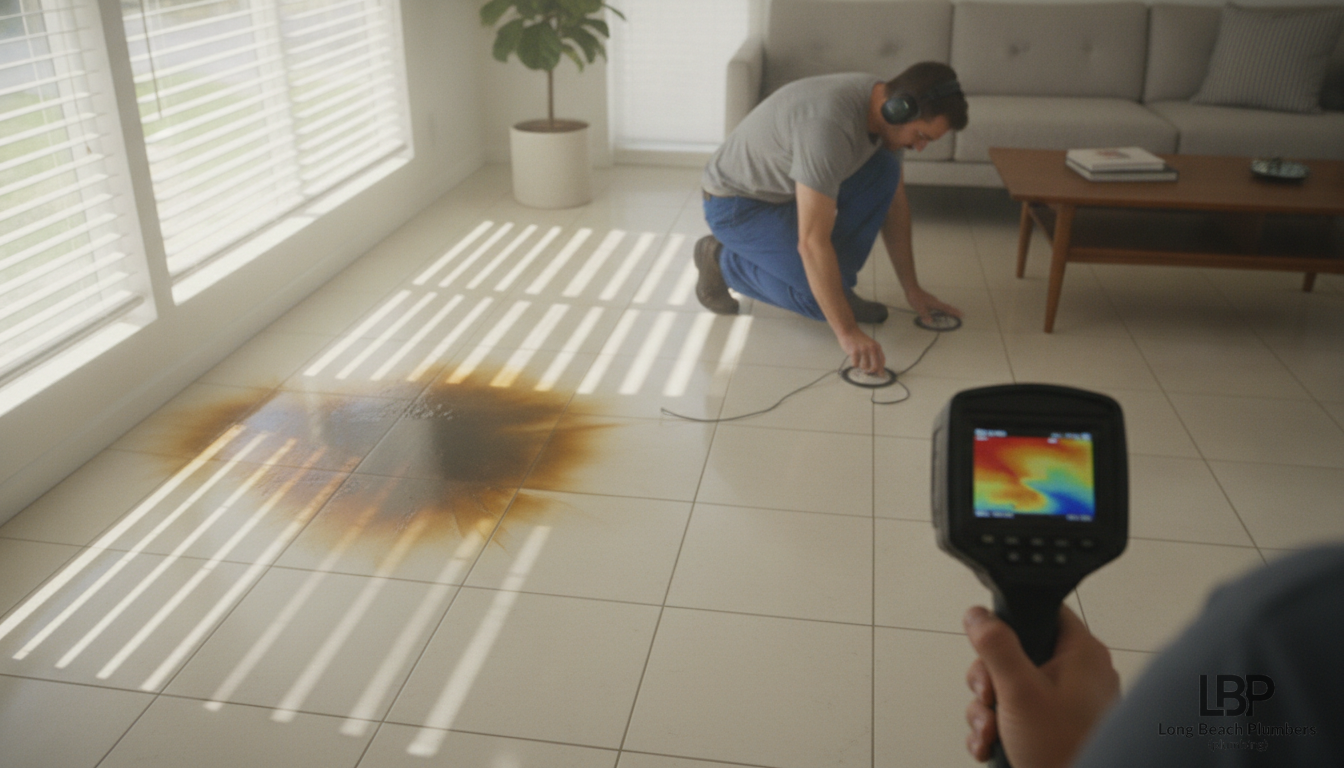
- Electronic acoustic detection — Sensitive listening disc sensors are placed directly on the slab surface and connected to a digital amplifier that filters out background noise and amplifies the specific frequency signature of pressurized water escaping through a pipe crack. Our technician systematically maps the leak sound across the slab to triangulate the exact location.
- Thermal imaging — For hot water line leaks, a thermal camera reveals the temperature differential between the leak point and surrounding slab as a clear visual map. This is especially effective in homes with tile floors where temperature transfer through the slab is efficient.
Once the leak location is confirmed, we mark the slab and walk you through every repair option before any work begins. There are no surprises.
Your Slab Leak Repair Options
After locating the leak, homeowners in Long Beach typically have three repair paths depending on the pipe's condition, location, and age:
- Spot repair (targeted jack-hammering) — If the pipe is otherwise in good condition and the leak is isolated, we cut concrete directly at the confirmed leak point, repair or replace the damaged pipe section, pressure-test the repair, and repatch the concrete. This is the least invasive approach when only one section of pipe has failed.
- Pipe rerouting through the walls — Rather than cutting into the slab at all, we run a new supply line through the interior walls of the home, bypassing the slab-embedded pipe entirely. The old pipe is capped and abandoned in place. This option avoids concrete work altogether and is often the most cost-effective choice when the slab pipe is corroded beyond spot repair.
- Epoxy pipe lining (trenchless) — For certain pipe configurations, an epoxy resin liner can be pulled through the existing pipe from cleanout access points, coating the interior pipe wall and sealing the leak without any excavation. This is a trenchless option worth discussing when pipe geometry allows it.
If a prolonged slab leak has caused water damage to drywall, flooring, or framing, we can coordinate with water damage restoration contractors to ensure remediation is handled alongside the plumbing repair.
What About Homeowner's Insurance?
Slab leak coverage varies significantly between insurance policies. Most standard homeowner's policies in California cover the cost of accessing the leak (the jackhammering and concrete repair) but may not cover the plumbing repair itself or resulting water damage depending on your policy language. A few important points:
- Document everything before any work begins — photos, water meter readings, and your plumber's written diagnosis are all valuable for a claim
- Some insurers require proof that the leak was sudden and accidental rather than the result of long-term neglect or deferred maintenance
- Ask your insurance agent specifically about your access and leak coverage limits before authorizing major slab work
Our leak detection report provides the written documentation most insurers require to process a claim.
Should You Repipe If You Have One Slab Leak?
One slab leak in a 60-year-old copper supply system doesn't automatically mean every pipe in your home is about to fail — but it is a strong signal that your plumbing is reaching the end of its service life. If our inspection reveals widespread corrosion, multiple pinhole pits, or thinning pipe walls throughout the system, a whole-home repipe may be more economical than paying for individual repairs as each section fails over the next few years.
We'll give you an honest assessment of your pipe's overall condition after the repair and let you make that decision with full information.
Serving Long Beach and the Surrounding Area
Long Beach Plumbers provides slab leak detection and pipe repair throughout Long Beach and neighboring communities including Signal Hill, Carson, San Pedro, and Seal Beach. We're available seven days a week, 8 AM to 6 PM.
If a slab leak has you concerned about your sewer system as well, combine your appointment with a sewer line camera inspection to get a complete picture of your home's underground plumbing in a single visit. Call us at +1 (562) 573-1788 or reach out by email at [email protected].